Anyone with a public profile online can find themselves at the centre of a pile-on: many accounts, often at once, directing abuse at one person. This article explains what the UK government and Ofcom’s guidance on a safer life online for women and girls say platforms should do about it, and where that guidance differs from the legal duties in the Online Safety Act. It describes the position in the United Kingdom only, as published by the UK government as of 14 October 2026.
What is a pile-on, and why does it matter to people in the public eye?
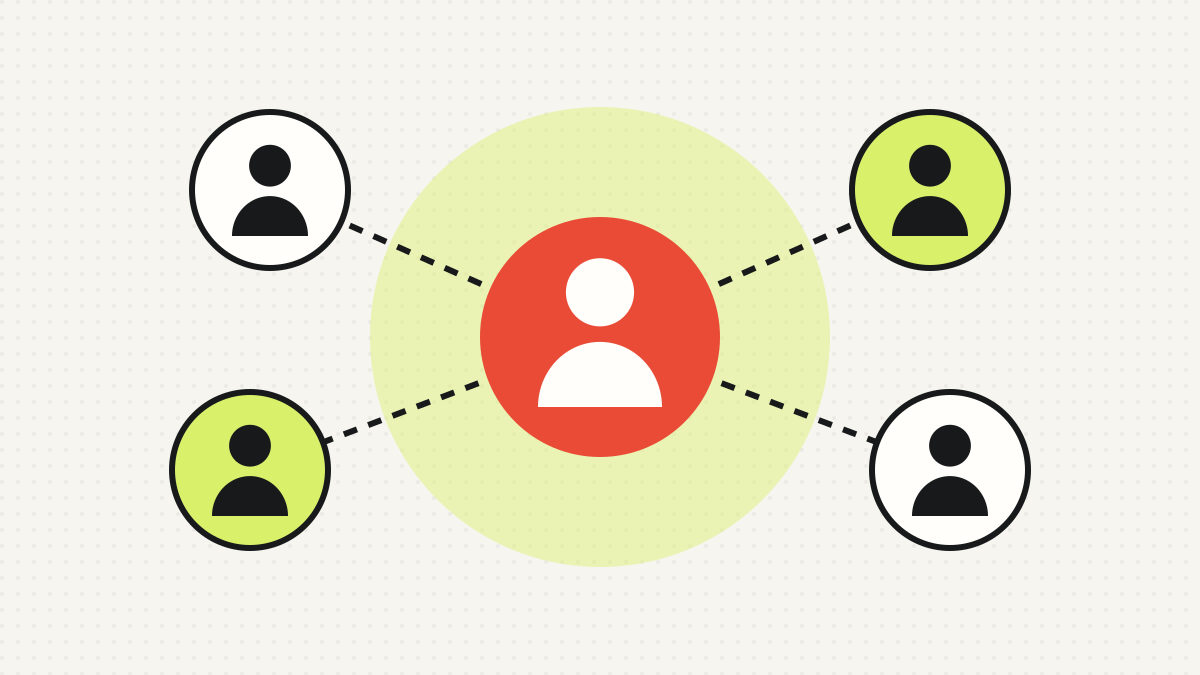
A pile-on is a burst of coordinated or near-simultaneous abuse aimed at one person or a small group. UK government material uses the phrase “pile-ons and coordinated harassment” and treats it as one of several gender-based online harms needing urgent action, according to the letter the Secretary of State for Science, Innovation and Technology sent to online service providers on 23 March 2026.
For creators, presenters, founders and commentators, visibility is part of the job. The same visibility can make a sudden surge of hostile replies, tags and messages hard to manage by hand. The practical tools a creator controls, such as comment filters, are covered in our guide to how creators moderate comments on YouTube. This piece looks at the other half: what platforms themselves are being asked to build.
What does Ofcom’s guidance on women and girls actually cover?
Ofcom is the UK’s independent online safety regulator. According to the Government’s Online Safety Act explainer, the Act requires Ofcom to produce guidance summarising measures that tackle online abuse which women and girls disproportionately face. The explainer says Ofcom published draft guidance on 25 February 2025 for a 12-week consultation, with final guidance due by the end of 2025.
A UK government press release of 10 March 2026 says Ofcom issued the final guidance about three months earlier. It describes measures companies “can take” to reduce misogynistic abuse, harassment, stalking and image-based sexual abuse. Measures that the press release names include:
- prompts that ask users to reconsider harmful posts;
- limits on pile-ons;
- stronger privacy defaults;
- hash-matching for intimate images.
The Secretary of State’s March letter adds further steps drawn from the guidance:
- risk assessments focused on harms to women and girls;
- “abusability” evaluations before new features and services launch;
- strong, customisable default settings for interaction and privacy;
- demonetising user-generated content that promotes misogynistic abuse and sexual violence;
- reducing the prominence of that material in search results and recommender feeds;
- rate limits to prevent mass-posting in pile-ons.
The guidance is aimed at the platforms rather than at users. It also concerns women and girls specifically; it is not a general code for every kind of abuse of every person.
Is the guidance legally binding?
Not in the way the Act’s duties are, on the sources read for this article. The Secretary of State’s letter describes Ofcom’s measures as “recommended” and states an expectation that platforms implement them. It does not call the guidance mandatory. The March press release likewise does not say the guidance is binding and its wording reads as advisory, and it threatens unspecified “further action” if companies do not act.
That is the article’s reading of the wording rather than a legal finding, so anyone needing certainty about the legal status should check Ofcom’s own statement.
| Item | What the published UK government sources say |
|---|---|
| Ofcom guidance on women and girls | Describes measures companies “can take”; letter calls them “recommended” |
| Government expectation | Letter: “I expect all platforms to implement Ofcom’s guidance by the end of this year at the latest” (letter dated 23 March 2026) |
| Illegal content duties | Services must have systems to remove illegal content, including harassment, when it is flagged to them |
| Fines for breaching the Act | Up to £18 million or 10% of qualifying worldwide revenue, whichever is greater |
What is a platform legally required to do about harassment?
The Online Safety Act is a separate layer. The government’s explainer says the illegal content it covers includes harassment, stalking, controlling or coercive behaviour and intimate image abuse, and that all user-to-user and search services must have systems to remove such content when it is flagged to them. It also says offences including cyberflashing and threatening communications took effect on 31 January 2024.
On enforcement, the explainer says Ofcom has broad powers to assess and enforce compliance and that companies can be fined up to £18 million or 10% of qualifying worldwide revenue, whichever is greater. Illegal content enforcement began in March 2025, according to the same page.
Not all abuse is illegal. Much hostile but lawful content falls outside the removal duty, which is one reason the guidance on measures like rate limits and prompts matters: it targets behaviour patterns, not only individual posts.
What are rate limits and why are they named?
The Secretary of State’s letter asks for “implementing rate limits to prevent mass-posting in pile-ons”. The letter does not explain how rate limits should work or set out enforcement details, so the following is general explanation rather than a description of any platform’s system.
A rate limit caps how much one account, or accounts behaving in a similar way, can post, reply or tag within a given time. In a pile-on, the harm often comes from volume: a target may receive far more messages than any person could read. Limiting how fast new replies can arrive is one way of slowing that surge. How a given platform would do this, and whether it is already doing so, is not described in the sources read for this article.
What do user empowerment tools add?
The government explainer describes optional tools for adults on the largest services, which it calls Category 1. They include tools to verify identity, to reduce content from non-verified users and to block non-verified users from interacting. It says these services must proactively offer tools to reduce exposure to certain legal content, including abusive or hateful content, and that the tools must be “effective and easy to access”. The explainer gives no date for these duties and refers to Ofcom’s register of categorised services, which it expected in summer 2025.
The explainer also says Category 1 services must have effective reporting and redress mechanisms so users can challenge how terms of service are enforced. Whether a particular platform counts as Category 1 is a matter for Ofcom’s register, which this article has not examined.
What did ministers say they would do if platforms do not act?
The 10 March 2026 press release says Technology Secretary Liz Kendall met leading platforms, including Snapchat, Meta, YouTube and TikTok, on 9 March 2026. It quotes her: “Now, tech companies must go above and beyond to use the tools readily available to them to make their platforms safer.” It also says that if companies do not act, “they are enabling abuse to thrive.”
The release says Ofcom is expected to report which platforms are failing to comply, and that the government wants this done quickly. It also notes a separate binding requirement: intimate images shared without consent must be removed within 48 hours of being flagged. The letter of 23 March repeats the 48-hour figure and says the government is “legislating” for it. The same release says intimate image abuse, cyberflashing and choking are now priority offences under the Online Safety Act.
How might the pieces fit together for a creator or their team?
The sources describe duties and expectations for platforms, not instructions for individuals. Taken together, and as the article’s own summary rather than the government’s, there are three layers to keep apart:
- Tools the creator controls, such as filters, hidden users and moderation settings on a particular service.
- Platform duties in law, such as having systems to remove flagged illegal content.
- Platform measures that are recommended, such as pile-on limits, reconsideration prompts and safer defaults.
Teams that manage a public profile may find it useful to know which layer a problem belongs to before deciding where to report it. Our explainer on who works behind a creator describes the community managers and moderators who often take first contact. For wider context on how audiences are shaped, see our guide to media literacy and why Ofcom promotes it.
What is the position as of 14 October 2026?
The government’s March letter set an expectation that platforms implement Ofcom’s guidance by the end of 2026. The sources read for this article do not report which platforms have done so. They also do not say how Ofcom will publish any assessment of compliance, so readers should look to Ofcom for any update. The guidance concerns the UK and UK-regulated services; rules and platform commitments elsewhere, in the US or the EU for example, differ and are not covered here.
Conclusion: recommended measures are not the same as legal duties
UK government sources draw a line between what the Online Safety Act requires, such as systems to remove flagged illegal content, and what Ofcom’s women and girls guidance recommends, such as limits on pile-ons and stronger defaults. Pile-ons sit in the second category, where government expectation is high but the published wording is advisory. For people with public profiles, the useful reading is that platform design is now an explicit part of the debate, with a stated end-of-2026 expectation to watch.
This article gives general information based on published UK government material as of 14 October 2026. It is not legal or safety advice, and laws, guidance and platform policies change.
Sources: GOV.UK (Commitment to halve violence against women and girls: letter from DSIT Secretary of State to online service providers); GOV.UK (Tech companies must go ‘above and beyond’ to protect women and girls from online abuse or face further action); GOV.UK (Online Safety Act: explainer)